- Tom
- blockchain, commerce, Technology, trade
- 0 Comments
- 18870 Views
What is blockchain used for? Blockchain in Trade and Commerce
1/ Key takeaways
Blockchain technology revolutionizes global trade by digitizing physical documentation and streamlining complex logistics workflows. Consequently, enterprise leaders can eliminate costly operational fraud while unlocking vital liquidity for cross-border commerce.

2/ What is blockchain used for? Blockchain in Trade and Commerce
2.1. What are the benefits of blockchain in trade and commerce?
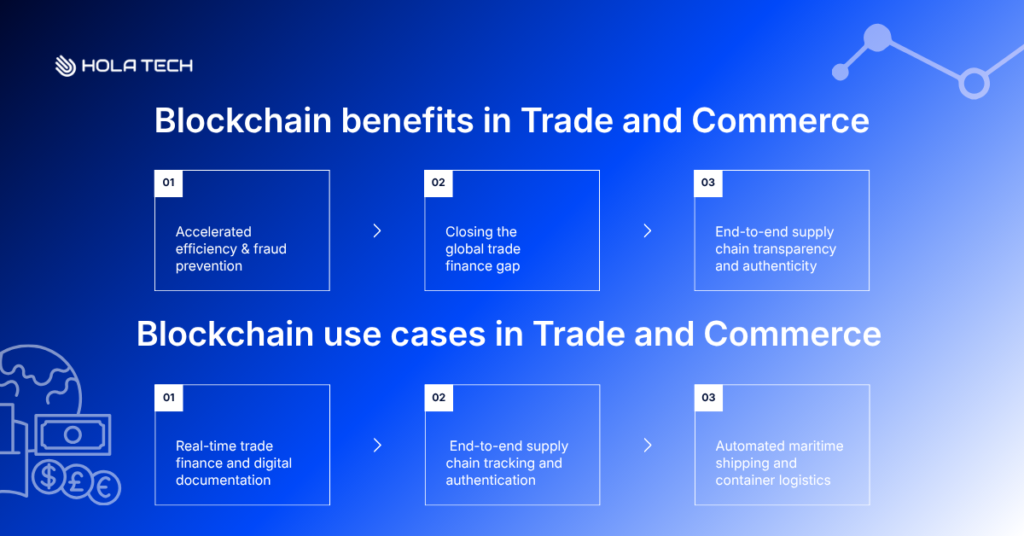
– Accelerated operational efficiency and fraud prevention: International trade relies on paper-based documents that take up to 120 days to process. Blockchain tokenizes letters of credit and bills of lading onto an immutable distributed ledger to prevent double-financing fraud. Consequently, automated smart contracts eliminate manual bottlenecks and accelerate settlement cycles.
– Closing the global trade finance gap: Emerging market enterprises frequently face rejections from risk-averse financial institutions due to high compliance costs. Enterprise Ethereum networks streamline regulatory processes and lower Know-Your-Customer overhead through a transparent transaction history. Furthermore, tokenized marketplaces allow alternative investors to provide liquidity directly to underserved businesses.
– End-to-end supply chain transparency and authenticity: Complex logistics networks struggle to verify product provenance and combat counterfeit goods. Linking physical commodities to unique digital tokens creates an unalterable single source of truth across all transit milestones. Moreover, smart contracts automatically enforce channel distribution rules, which protects brand integrity and optimizes post-sale operations.
2.2. Top blockchain use cases in trade and commerce
– Real-time trade finance and digital documentation: Platforms like Contour tokenized letters of credit to drastically streamline cross-border transaction processes. Furthermore, research highlights how digitized bills of lading on permissioned networks lower document processing times by up to 80%. Consequently, smart contracts validate agreements instantly to remove costly paperwork bottlenecks and prevent double-financing fraud.
– End-to-end supply chain tracking and authentication: IBM Food Trust utilizes distributed ledger technology to provide absolute visibility across complex distribution channels. Additionally, enterprise networks connect physical products to digital tokens to verify raw material sources. As a result, stakeholders easily detect counterfeit goods and protect brand integrity throughout the entire retail lifecycle.
– Automated maritime shipping and container logistics: Industry consortiums like TradeLens demonstrate how permissioned ledgers optimize multi-party maritime workflows despite historical data-sharing hurdles. Moreover, research studies validate that decentralized frameworks synchronize real-time shipping records among independent supply chain partners. Therefore, international logistics providers can automate customs clearance and resolve expensive shipping delays efficiently.
3/ Hola Tech’s pov:
At Hola Tech, we see blockchain as the ultimate catalyst for modernizing global trade and commerce. Legacy trade architectures remain severely constrained by fragmented paper documentation, delayed settlements, and high compliance overheads. By deploying decentralized ledgers and automated smart contracts, enterprises can convert slow physical operations into near real-time digital assets. Furthermore, blockchain establishes an immutable, single source of truth that dramatically reduces fraud risks like double financing. Consequently, businesses unlock vital working capital, streamline cross-border shipping workflows, and expand global market accessibility with total transparent trust.
For leaders aiming to integrate blockchain effectively, enterprise success requires a pragmatic implementation strategy. First, avoid building entirely isolated systems by prioritizing interoperability standards that connect legacy enterprise resource planning (ERP) platforms seamlessly with permissioned networks. Additionally, enterprise leaders should focus initial rollouts on targeted high-friction areas, such as digitizing letters of credit or automating track-and-trace logistics. Therefore, by collaborating early with consortium partners and experienced technical specialists, organizations accelerate digital transformation while protecting baseline operations.
Want to stay ahead of the curve in the world of decentralized technology and AI? Check out Hola Tech blog for more exciting technology news and useful information!

author
I leverage my skills in strategic planning, team coordination, and technology solutions as the Co-founder and COO of Hola Tech. Passionate about innovation and efficient problem-solving, I am dedicated to pushing the boundaries of what is possible in the tech industry with Hola Tech