
- Tom
- ai, Finance, Technology
- 0 Comments
- 14507 Views
The war for payments: Why the “Switzerland Strategy” will win the decade
1/ Key takeaways
Legacy systems currently struggle to keep pace with the instant speed of modern stablecoins. Consequently, the winning strategy involves using neutral aggregation layers to bridge these two financial worlds.
2/ The war for payments: Why the “Switzerland Strategy” will win the decade
1973 called. It wants its banking system back.
If you look at the financial infrastructure powering most global businesses today, you are looking at technology that was considered a marvel when Nixon was President. It was robust, it was revolutionary, and it connected the world.
But that was over 50 years ago.
Today, we are witnessing a quiet war for the future of value movement. It isn’t just about “Crypto vs. Fiat.” It is a battle between three distinct architectures competing for dominance.
To understand where the money is going, you have to understand the Three Settlement Layers.
Layer 1: The Legacy (SWIFT)
We all know this layer. It is the incumbent. It is established. It is the reason your international wire transfer takes three to five business days and costs you a hidden 3% in FX fees.
SWIFT is the “fax machine” of finance. It works, it is trusted, and it is everywhere. But in an era of instant gratification and algorithmic trading, “trusted but slow” is becoming a liability.
Layer 2: The Native Stablecoin Layer
Then came the disruptors. We saw the rise of purpose-built stablecoins like StraitsX (XSGD) and XUSD.
This layer solved the speed problem immediately. Settlement isn’t T+2; it’s T+0. It’s instant. It’s programmable.
However, it introduced a new problem: Fragmentation.
The stablecoin landscape is geographically and technologically fractured. A stablecoin that dominates in Singapore might have zero utility in New York. If you hold USDC but your vendor wants XSGD, you are stuck in a web of exchanges and conversion fees. It is fast, but it is messy.
The Mistake Founders Make
Here is where most entrepreneurs and institutions get it wrong. They look at these two layers and think they have to pick a side.
They either cling to the legacy systems because they are “safe,” or they bet the farm on a single stablecoin ecosystem, hoping it becomes the global standard.
Stop doing that.
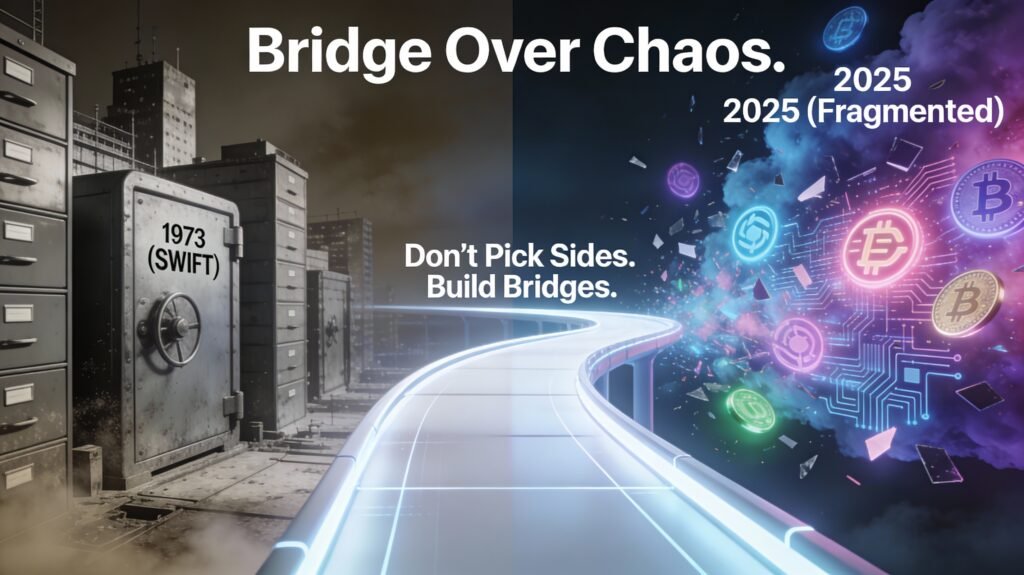
The real winner in 2025 isn’t the company that picks a side. It’s the company that connects them.
Layer 3: The Aggregation Layer
This is the future. This is the infrastructure layer that wins.
The Aggregation Layer functions as the “Switzerland” of finance. It is neutral. It is intelligent. It doesn’t care if the money comes in via a 50-year-old wire transfer or a split-second blockchain transaction.
Its only job is to route value between the dinosaurs and the futurists without blinking.
This layer bridges the gap. It offers multi-stablecoin intelligent routing, allowing businesses to hold assets in one form and settle in another, seamlessly.
The APAC Example: MetaComp
We are already seeing this play out in the APAC region. Look at MetaComp.
While other players are fighting to make their specific stablecoin the winner, MetaComp has taken the aggregation approach. They aren’t trying to be the bank, and they aren’t trying to be the only coin in your wallet.
They are positioning themselves as the neutral aggregator – a digital payment institution that allows for the seamless flow of value across both traditional finance and the fragmented world of Web3.
By refusing to be “proprietary stablecoin owners” and instead acting as the bridge, they appeal to institutional clients who need a multi-stablecoin strategy, not a philosophical debate about which token is better.

3/ The verdict:
If you are building a business in this space, or just trying to navigate it, remember this:
Don’t try to own the coin.
Own the infrastructure that lets you use all of them.
That is the strategy that wins.
Want to stay ahead of the curve in the world of decentralized technology and AI? Check out Hola Tech blog for more exciting technology news and useful information!

author
I leverage my skills in strategic planning, team coordination, and technology solutions as the Co-founder and COO of Hola Tech. Passionate about innovation and efficient problem-solving, I am dedicated to pushing the boundaries of what is possible in the tech industry with Hola Tech