- Tom
- ai, News, Technology
- 0 Comments
- 19872 Views
Anthropic launches Opus 5
1/ Key takeaways
The newly launched Opus 5 delivers state-of-the-art long-horizon reasoning and exceptional cost efficiency, though developers must carefully navigate its strict safety guardrails and unpredictable usage limits.
2/ Anthropic launches Opus 5
2.1. What is Opus 5?
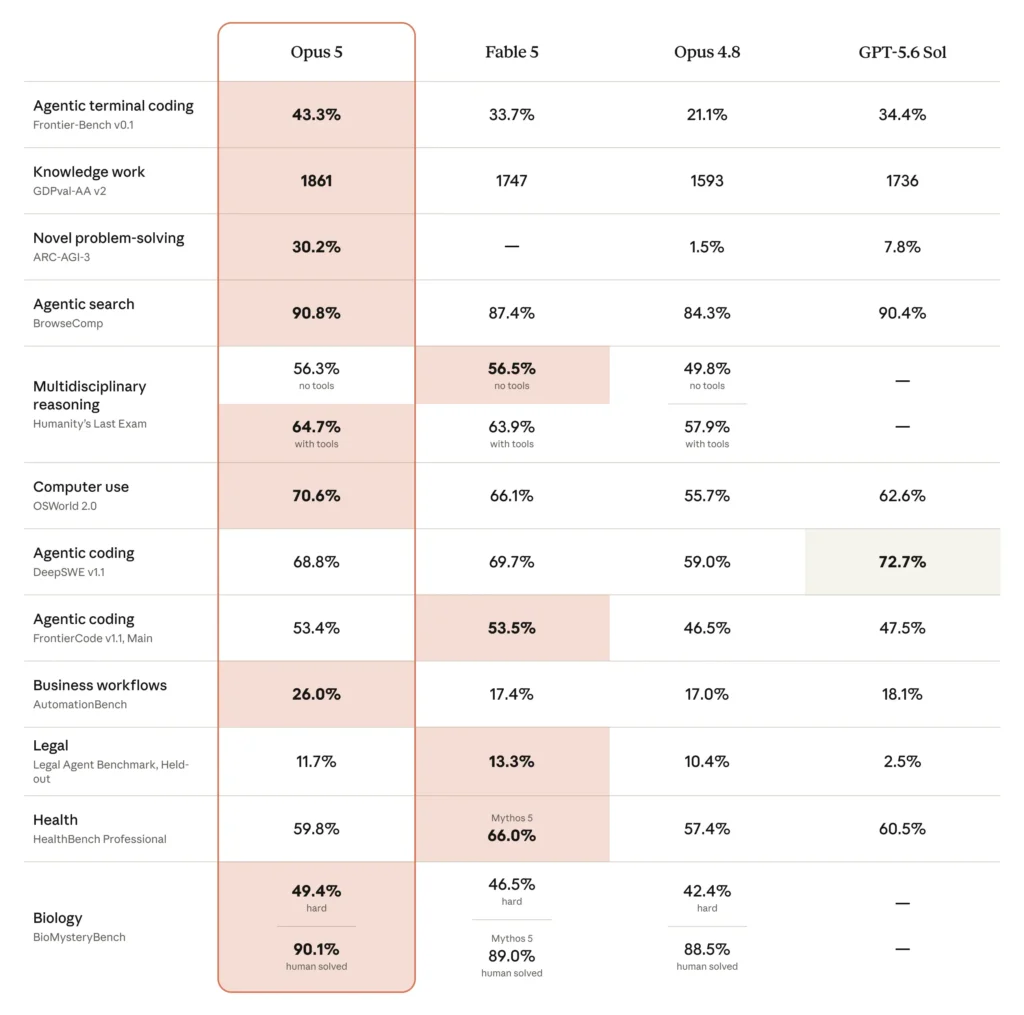
Anthropic has officially launched its new Opus 5 model, arriving just two months after the release of Opus 4.8. Despite being smaller than Fable 5, this latest heavyweight model beats it on key benchmarks while offering a cheaper and less restrictive user experience. Furthermore, Anthropic designed the system to excel at verifying its own work and carefully iterating until it succeeds.
Privacy-conscious users will appreciate that Opus 5 avoids the strict 30-day data retention policy that affects other models. However, it still maintains crucial safeguards regarding cybersecurity tasks like exploit generation to prevent misuse. Developers can access the model across all platforms via the Claude API at $5 per million input tokens and $25 per million output tokens.
2.2. Opus 5: Review from real users
Opus 5 receives mixed reviews, with users praising its long-horizon task capability and cost efficiency at lower effort settings, but many also report inconsistent performance, ‘nerfing’ over time, and restrictive guardrails, especially for security-related tasks. While some find it to be a significant upgrade, others experience regressions in reasoning and an overly verbose or “jargony” communication style compared to previous versions like Opus 4.8 or Fable.
Specifically, Redditors highlight Opus 5’s ability to tackle complex, multi-step tasks efficiently, with some noting its performance is comparable to or even surpasses Fable 5 in certain areas, particularly when using “Low effort” settings. However, a significant number of users express frustration with its perceived lack of depth in reasoning, tendency to “gaslight” by making up information, and a frustrating habit of repeating errors. The strict guardrails are a common point of contention, preventing certain legitimate security and development tasks, leading some to explore open-source alternatives.
3/ Hola Tech’s pov:
To get the absolute best results out of Opus 5 without burning through your token limits, you need a targeted prompt engineering approach. First, actively combat its tendency toward over-engineering by explicitly instructing the model to “keep responses focused, brief, and concise.” Next, segment complex tasks system by system rather than throwing massive network architecture at it all at once to avoid unexpected guardrail blocks or deep over-analysis. Additionally, you should leverage a mixed-model workflow to stretch your budget and maximize technical output efficiency. For example, assign planning and high-level orchestration to models like Fable 5, while reserving Opus 5 strictly for execution, heavy coding, QA, and driving MCP tools. This hybrid approach keeps your pipeline running smoothly, cuts down on unnecessary fluff, and extracts top-tier performance from every single session.
Want to stay ahead of the curve in the world of decentralized technology and AI? Check out Hola Tech blog for more exciting technology news and useful information!

author
I leverage my skills in strategic planning, team coordination, and technology solutions as the Co-founder and COO of Hola Tech. Passionate about innovation and efficient problem-solving, I am dedicated to pushing the boundaries of what is possible in the tech industry with Hola Tech