- Tom
- Cybersecurity, Technology, Vault
- 0 Comments
- 21315 Views
Is vault safe to use?
1/ Key takeaways
Vault provides enterprise-grade zero-trust security through robust encryption and dynamic credential management across complex multi-cloud environments. However, maximizing its protective capabilities requires strict operational hygiene, least-privilege access policies, and dedicated DevOps expertise to prevent misconfigurations.
2/ Is vault safe to use?
2.1. Is HashiCorp Vault secure?
HashiCorp Vault is secure when implemented with proper configuration. It relies on robust encryption to protect sensitive data both at rest and in transit across complex cloud infrastructures. Furthermore, its fine-grained access control lists and token-based authentication ensure that only authorized entities can access specific secrets.
However, security depends heavily on operational hygiene. Misconfigured policies or improper management of unseal keys can introduce significant vulnerabilities into your pipeline. Organizations must enforce strict least-privilege principles and enable comprehensive audit logging to maintain a secure posture. Regular security reviews help catch misconfigurations before attackers exploit them.

2.2. HashiCorp Vault vs. Alternative Secret Managers
When comparing HashiCorp Vault against native cloud alternatives like AWS Secrets Manager or Azure Key Vault, architectural flexibility becomes the main differentiator. Vault excels in multi-cloud and hybrid environments by providing a unified secret management layer independent of any single cloud provider. Native solutions offer simpler setup processes if your stack remains locked into one specific cloud ecosystem.
Beyond deployment targets, feature sets diverge significantly regarding dynamic secrets and automated rotation workflows. Vault provides advanced dynamic secret generation for databases and APIs, reducing the lifespan of static credentials. Native cloud managers often require custom scripting to achieve the same level of automated secret rotation. Choosing the right tool depends on your infrastructure scale and multi-cloud requirements.
3/ Hola Tech’s pov:
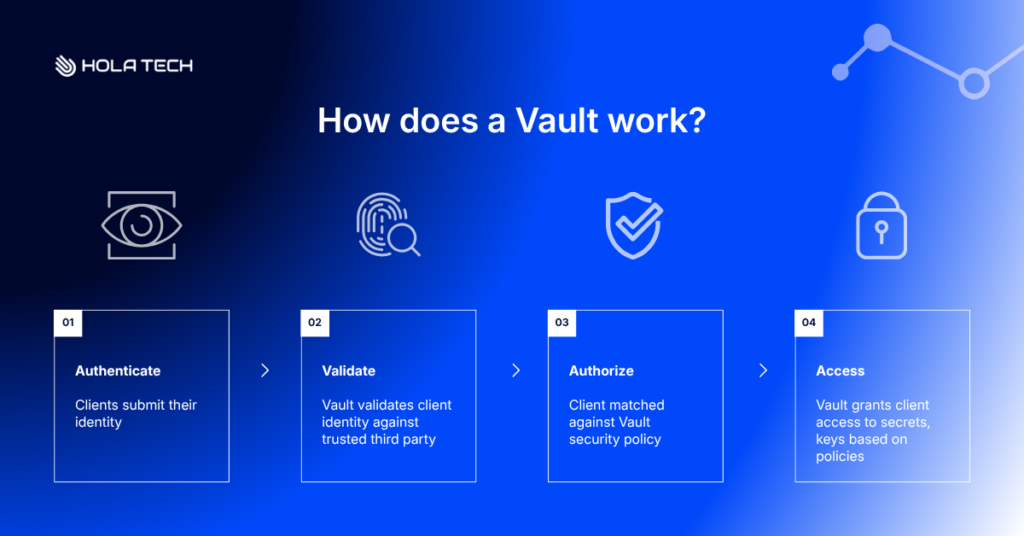
Achieving production-grade security with HashiCorp Vault requires a strict defense-in-depth approach tailored to your threat model. First, enforce rigid least-privilege policies using fine-grained Access Control Lists (ACLs) to constrain token privileges. You must restrict root token usage exclusively to initial bootstrapping. Immediately revoke or seal root credentials after setup. To eliminate human error during cluster reboots, configure auto-unseal mechanisms using cloud Key Management Services like AWS KMS, Azure Key Vault, or GCP KMS. Additionally, enable full audit logging to stream request and response headers to secure log aggregators. This practice ensures total visibility across your identity ecosystem. Regularly rotate intermediate Certificate Authority (CA) certificates and database credentials to minimize potential blast radiuses.
If your infrastructure spans multiple cloud providers or hybrid environments, Vault provides an unbeatable unified control plane. Its dynamic credential engine eliminates long-lived static secrets across databases, Kubernetes clusters, and cloud APIs. However, Vault introduces non-trivial operational complexity that requires dedicated DevOps engineering oversight. Small development teams running simple, single-cloud deployments might find native offerings like AWS Secrets Manager or Azure Key Vault sufficient and easier to maintain. At Hola Tech, we recommend conducting a thorough security audit of your pipeline before migrating. Choose Vault when centralized compliance, multi-cloud agility, and zero-trust orchestration are top architectural priorities.
Want to stay ahead of the curve in the world of decentralized technology and AI? Check out Hola Tech blog for more exciting technology news and useful information!

author
I leverage my skills in strategic planning, team coordination, and technology solutions as the Co-founder and COO of Hola Tech. Passionate about innovation and efficient problem-solving, I am dedicated to pushing the boundaries of what is possible in the tech industry with Hola Tech